

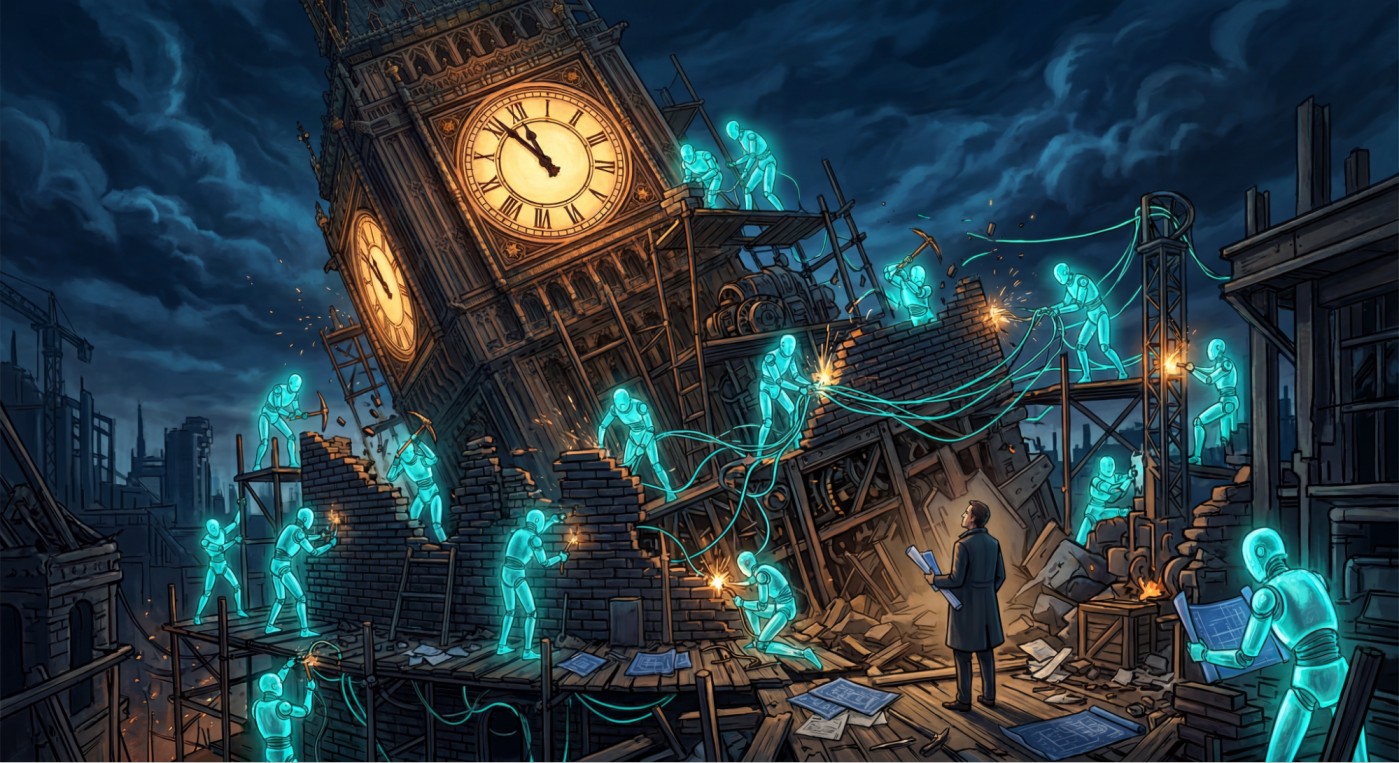


In 1975, IBM software engineer Fred Brooks published The Mythical Man-Month, giving the tech world one of its most enduring and unforgiving maxims: "Adding manpower to a late software project makes it later."
For fifty years, Brooks’s Law held true. But fast forward to 2026, and the landscape of software engineering is virtually unrecognizable. We have entered the era of "vibe coding"—a term popularized by Andrej Karpathy in early 2025, where humans write prompts in natural language and let AI handle the syntax. We have also seen the explosive rise of agent swarms—frameworks like OpenAI Swarm, CrewAI, and AutoGen, where autonomous AI agents take on specialized roles (PM, Developer, QA) and collaborate to build software.
When a new "developer" can be spun up in milliseconds, costs pennies an hour, and can ingest a 2-million-token codebase in seconds, it’s tempting to declare Brooks’s Law dead. If a project is running late today, why not just spin up fifty more agents?
Because of what I call The Mythical Agent-Minute. AI has indeed solved the problem of typing speed, but it has not solved the fundamental laws of system complexity. Here is a look at the history of Brooks's Law, how vibe coding changes the math, and why blindly throwing AI agents at a late project will only result in faster, more catastrophic failures.
The History of the Mythical Man-Month
Brooks’s original premise was that measuring work in "man-months" implies that human beings and time are perfectly interchangeable. They aren't. Brooks identified three core reasons why adding people to a late project spells disaster:
- Ramp-Up Time: New developers need weeks or months to understand the architecture, business logic, and codebase.
- Communication Overhead: The number of communication paths increases exponentially with team size n(n−1)/2. More people equals more meetings, friction, and misaligned assumptions.
- Task Partitionability: Some tasks are inherently sequential. As Brooks famously quipped, "Nine women can't make a baby in one month."
Does Brooks's Law Still Apply in the Age of Vibe Coding?
At first glance, AI seems to neutralize Brooks's bottlenecks.
- Ramp-up time is dead: With Retrieval-Augmented Generation (RAG) and massive context windows, an AI agent doesn't need a two-week onboarding sprint. It reads the entire repo in seconds.
- Communication speed is instant: Agents communicate via structured API calls at lightspeed, without needing a Slack huddle.
Yet, the core of Brooks's Law remains terrifyingly relevant. The bottlenecks haven't disappeared; they have simply shifted from human constraints to structural ones.
If you add more human "vibe coders" to a late project, you still have human communication overhead. Two humans prompting two different AI agents to build intersecting features will generate conflicting code at an unprecedented velocity.
If you add more AI agents to a swarm, communication overhead becomes orchestration overhead. Agents can get caught in infinite feedback loops, suffer from cascading hallucinations, or lose track of the core architectural vision. Furthermore, sequential tasks remain sequential. An AI swarm cannot test a database schema that an Architecture Agent hasn't finished drafting yet.
Real-World Case Studies: The "Vibes" vs. Production Reality
The last couple of years have provided us with stark examples of what happens when we assume AI invalidates the laws of software engineering.
1. The GitClear Code Quality Crisis (The Cost of "Accept All") When Karpathy popularized vibe coding, his mantra was: "I 'Accept All' always, I don't read the diffs anymore." This works brilliantly for weekend prototypes, but in enterprise software, it creates a nightmare. A massive longitudinal study by GitClear analyzing 211 million lines of code from 2020 to 2024 revealed the hidden cost of AI assistance: code duplication increased by roughly 400%, and "code churn" (code pushed and then quickly rewritten or reverted) nearly doubled. Adding AI to speed up a project often just generated technical debt at an accelerated rate.
2. The Payment Routing Bug (Namanyay Goel's Case Study) Developer Namanyay Goel recently highlighted the danger of treating vibe coding as a silver bullet in production. When a critical payment routing bug hit his AI dev tool at 1 AM, he realized he couldn't just paste the error into an LLM and pray. He had to possess a deep, structural understanding of the request flow to fix it. When developers surrender codebase comprehension to AI, a late project cannot be saved by adding more prompts. The humans in charge no longer understand the system well enough to orchestrate the swarm.
3. Swarms Only Work With Rigid Orchestration Conversely, we've seen immense success from engineers building localized swarms—like Obie Fernandez using SwarmSDK to organize decades of Dropbox files, or data teams using multi-agent setups to analyze BigQuery. However, these successes have one thing in common: a single human architect strictly defined the agents' roles, states, and handoffs. They didn't throw a generic swarm at a late software deadline; they used the swarm to automate a perfectly understood, highly partitioned task.
Lessons Learned for the Next Step
As we navigate 2026 and beyond, software development is no longer about who can type syntax the fastest. It is about Context Engineering and System Architecture. Here are the lessons we must carry forward:
1. Shift from "Typer" to "Architect"
The human developer’s job is no longer to write code, but to deeply understand the architecture, edge cases, and constraints. You cannot vibe code a complex distributed system without a rock-solid blueprint. If the blueprint is flawed, a swarm of 50 agents will simply build the wrong system 50 times faster.
2. Context is More Valuable than Compute
A single AI agent with perfect, curated context (access to Slack decisions, GitHub PR histories, and architectural trade-offs) will drastically outperform a swarm of 10 agents working with generic prompts. If a project is late, don't add more agents—fix the context you are feeding the ones you already have.
3. Beware "Integration Hell 2.0"
In a multi-agent system, the handoff between agents is where software breaks. If the "Front-End Agent" and the "Back-End Agent" hallucinate slightly different API payloads, you will spend more time debugging their miscommunications than you would have spent writing the code yourself.
Conclusion: Brooks’s Law 2.0
Fred Brooks warned us that software development is an exercise in managing complexity, not just a matter of labor hours. In the era of vibe coding, typing has been commoditized, but complexity has multiplied.
It is time to update the classic law for the modern era:
"Adding more vibe coders or AI agents to a poorly architected, late software project just makes it fail faster and more confusingly."
The Mythical Agent-Minute is an illusion. We have unlimited digital hands, but we still only have one overarching system architecture. Protect it, understand it, and use AI to build it deliberately.
Ready to scale your AI securely? Let's talk.